
Who does what, with which information, where and when
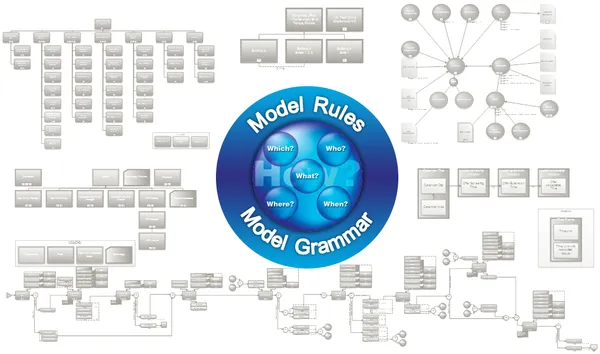
Using a method and a system of diagrams based on an intuitive framework of five Ws (who does what, with which information, where and when), we give our clients a comprehensive view of their enterprise. It clarifies the complex relationships between information, people, resources and technology.
The six dimensions
Each question is a dimension of the model, shown in its own colour.
- WHAT
The activities that achieve a business purpose
Everything the business does, in one tree. The top activity states the business purpose, and each activity breaks down into the activities that together make it up, numbered in order. Each is named by an action and its object, such as “Approve Purchase Order”.
- WHO
The organisations, roles, people and technology that do the work
They sit in one hierarchy, and systems count as a who too. For every activity, the model records who is Responsible, Accountable, Consulted and Informed.
- WHICH
The information activities need and produce
The information the business runs on: records, events, and the documents and forms it handles. Each has its details and the states it passes through, and the model shows which activities create, change and use it.
- WHERE
The places work happens
Physical places, or virtual ones with their own address, grouped by region or site.
- WHEN
The time frames that govern it
Each time frame is built from units of time, and time frames are related to one another.
Why use W5
- 01Quickly and intuitively provide a complete and consistent definition of the business.
- 02Easily extract the data the way you want it, when you want it.
- 03Make the data easily accessible to anyone, anywhere, at any time.
- 04Integrate with existing enterprise systems.
- 05Empower your people to make decisions based on facts, not speculation.
A revolutionary way to describe business
A revolutionary way to describe business: the W5 business modelling language is an intuitive graphical language that unlocks the DNA of a corporation using a system of diagrams based on five Ws (who, what, which, where, when). It gives companies a complete and accurate map of their enterprise, which they can reuse again and again to describe, plan and improve.
Business Genetics: Understanding 21st Century Corporations using xBML
by Cedric G. Tyler and Stephen R. Baker (Wiley)
It's time to throw out the flow charts. xBML breaks down the silos of an enterprise and provides the means for clear, concise communication between all members of the organisation. Tyler and Baker provide a complete guide to xBML, and to why unlocking an organisation's Business Genetics will lead to quantifiable business improvement.